“Maybe this world is another planet’s hell.”

I must have been about 14 when I read the above quote by Aldous Huxley. I’d purchased the science magazine OMNI, and there were always a couple of pages that had historical quotes that, depending on the issue, either destroyed or restored my faith in humanity. At the time – 1984 – the threat of nuclear war between the Americans and the USSR was palpable. Even the Doomsday Clock from the Bulletin of the Atomic Scientists crept up a few minutes to reach 3 minutes to midnight. The scientists noted in their editorial for that year, “We thus stand at a fateful juncture, at the threshold of a period of confrontation, a time when the blunt simplicities of force threaten to displace any other form of discourse…This is an appalling prospect.”

Guess what; in January of this year the folks at the Bulletin pushed the Doomsday clock to 90 seconds to midnight. In case you’re wondering, midnight is the apocalypse. As you might expect, a driving factor moving the clock forward in the past year was the war in Ukraine. At the time the Doomsday clock published its editorial, the death toll in that war was close to 7,000 after nearly one year of fighting. Just over two weeks into the Israel-Hamas war, the death toll is creeping to that figure (1,400 Israelis and over 5,000 Palestinians). Those numbers will only increase in the near future.

Much like the reflections of the Doomsday editors back in 1984, the current war between Israel and Hamas must have a better endgame other than “blunt simplicities of force.” As many commentators, analysts and activists have noted, there will come a point when Israel’s retribution wears thin with other nations, and there will be greater demands to move towards a solution that goes beyond flattening an entire population. The continued violence plays right into the hands of Hamas leaders: they do not value life, whether it’s the life of an Israeli or a Palestinian; their actions prove that. The heinous acts committed by Hamas on October 7 must never be allowed to happen again. And however painful these acts were – and their lasting consequences on families, friends, the nation of Israel, and Jews around the world, we – the most collective “We” as humans on this Earth – must find the strength to maintain our faith in humanity. As Yuval Noah Harari noted recently, “Hamas is waging war on our souls…Hamas is trying to destroy our trust in humanity, and thereby destroy our own humanity.”

It won’t win; it can’t win. But Hamas’s disregard for all human life is taking a horrendous toll on people in Gaza. Every day I wake up to see more grim statistics on the scale of human suffering. Over 600,000 people internally displaced, over 5,000 of people killed – 62% of them women and children, over 15,000 injured, buildings and homes demolished, families homeless and distraught, no access to food, electricity and water – the convoys are welcome but insufficient given the enormity of the destruction. Thirty-five UNRWA staff killed.

Peace is not an option, at least not now. An increase in the flow of humanitarian aid is imperative, as would be a cessation of the bombings that are affecting innocent civilians. There needs to be a viable, diplomatic road to peace, which does not include Hamas in any way, but rather another form of leadership from Palestinians which can come to the table with Israel – with the support from the US and neighbouring Arab nations.

We won’t get there if our humanity is chipped away by Hamas. While the diplomatic options might seem unreachable, it doesn’t mean that we – once again the big “We” of planet Earth – should remain silent observers to the unfolding violence. You can sign a petition to call for a cease fire (I signed a petition that currently has a quarter million signatures), you can donate to a reputable organization that is providing aid to Gazans (like UNRWA; I worked for them for 6 years, they are reputable, competent, and essential to saving lives in Gaza, period) or offer support for survivors of the attacks in Israel, or – and I know this is harder than it actually sounds – talk to others about it. Don’t remain silent on what happened. Even if you don’t know how to start a conversation, but you feel that you should – with a Jewish friend, or a Muslim friend, or with anyone – it’s ok to start a dialogue with “I don’t know what to say.” We can’t be afraid to speak about this because we fear tensions might flair – denial has always been a poor way to tackle any issue. Losing our humanity in the face of these events reduces our perceptions to absurd simplicities that trample our empathy and can galvanize anger, demonization, and hatred.  An appalling prospect indeed, and not one I’m willing to give into. We are not another planet’s hell.

Planting flowers in Gaza, 2014.

Israel and Gaza: Struggling to Make Sense of the Violence

I am struggling to make sense of the recent events in Israel and Gaza. The barbarism and atrocities committed by Hamas on innocent Israeli citizens clenches my heart with an overwhelming sense of sorrow for the victims and their families. As one friend wrote to my wife, her family and friends in Israel are moving from bomb shelter to funeral. Families and communities have been shattered, and the horror of the massacre will surely impose a grief that will never leave the hearts of those left mourning.

This never should have happened. Israel, with all its state-of-the-art surveillance technology, should have seen Hamas preparing for these attacks in plain sight. A few years ago, I was standing next to an armoured UN vehicle on the Gaza side of Erez crossing, waiting to get my passport so I could travel the long, open corridor into Israel, and as I looked up in the sky, there was a surveillance balloon, which could most likely figure out my eye colour. Israel failed its citizens. Its initial reaction to the violence on its territory is unsurprising, given its past responses: unabated, incessant pounding of targets across Gaza. In a place as small as Gaza, civilian casualties are a tragic certainty, no matter how precise the strikes. The further escalation of Israel’s retaliation, from apparently using white phosphorus weapons, to cutting food, water and electricity, and now the absurd demand for one million Gazans to flee south is justifiably raising concern among the UN, aid agencies, nations around the world, and many of us seeing the suffering unfold through the news and social media.

Gaza and Israel have been through countless conflicts, with civilians paying the price on both sides, and however bad things seem now, I fear they will only get worse in the short term. Hamas, and Hezbollah in Lebanon, are backed by states and actors that seek to destabilize the region; it’s not hard to see how an escalating conflict in the region can descend into a devastating humanitarian crisis for millions of people.

I’ve been reluctant to speak about the conflict to many people in part because I am deeply troubled by what I’ve seen, and I know that a meaningful answer to “So, what do you think about what’s happening there?” is hardly achievable within the confines of any conversation. I’m also wary of people’s positions on Israel and Palestinians, which can be quite rigid, to the point where the conflict is reduced to a duality comprising of one side that is victimized and the other that is demonized. When someone is firmly on one side, even a tremendous effort to convince them that the other side is worth seeing through a lens that isn’t formed by bias is a daunting, if not impossible task. In case you think I’m favouring one “side” over the other, I’m not: I’ve talked about my work with Palestinian teachers on human rights to Jewish friends and acquaintances who cut me short and walked away from me, unwilling to hear what I had to say. I’ve worked in Gaza several times over the years, and there were Palestinians I met who still, incredulously, denied the Holocaust. Encouragingly – if it is even possible to see anything positive from this experience – I think the positioning of taking “one side” or another has been suffused by an enormity of grief experienced by all. There’s a greater empathy towards the plights of both Israelis and Palestinians, so many of whom continue to suffer, whether through loss of loved ones, displacement in a bombed-out hellscape, or living in anguish wondering about the fate of loved ones who remain hostages.

I’ve been to Gaza at least six times from 2011 until 2017, working as a consultant for UNRWA, the United Nations Relief and Works Agency. I helped create an agency-wide policy on human rights in schools, and worked on a couple of toolkits for teachers on how to integrate human rights values such as inclusion, equality, respect, and diversity into classroom activities. I provided training for hundreds of teachers and education specialists, who then went to on train thousands of other teachers in Gaza, but also other areas where Palestinian refugees live, including the West Bank, Jordan, Lebanon, and Syria. Of all the places I’ve been to, Gaza was the most hopeless. Buildings are either rundown, abandoned, bombed, or unfinished because construction materials are unavailable. With unemployment at 45% and over 80% of the population living in poverty, there’s hardly a reason to dream of a more prosperous future. Many children have suffered through more than one war in their short lifetimes – this latest one likely being the harshest.

The call by Israel to evacuate over a million people, as well as cut off water, food and electricity is, as many have put it, nothing short of a violation of international humanitarian law. That’s of little consequence to Israel, which has violated international humanitarian law in the past. What makes it especially egregious is the scale of the displacement, and the impending catastrophic impact it could have on Gaza’s population. To cite but one statistic, fifty thousand women are currently pregnant in Gaza, with five thousand of them expecting to deliver their babies within one month. In unsanitary conditions, without access to proper medical care, many of those infants may die. Hamas needs to be weeded out and eliminated – but a strategy that puts civilians at risk on such a large scale appears more vengeful than tactical. There has already been a tremendous amount of suffering; asking a beaten and broken population to cram into one of the most densely populated spaces on the planet is inhumane. Asking them to move along streets that are bombed out is outright impossible.

The scope of the unfolding tragedy is so fierce, deadly and volatile that there needs to be a path towards safety for all Palestinians, displaced or living in their homes, in whatever state these homes are left in. This means establishing a humanitarian corridor to channel food and water; it means the reestablishment of electricity, to power at a minimum hospitals and other centres where displaced people are taking refuge, like UN schools. If the Israeli Defence Force (IDF) can eliminate Hamas in the north of Gaza, that’s an obvious and welcome objective; destroying the tunnels will be a positive step towards that. But Hamas have embedded themselves in the population, and even if the IDF successfully eliminates a significant number of Hamas militants, it would be foolish to think that post-war Gaza (well, post-this-current-war Gaza) will be free of Hamas; if anything, a conflict of this scale could incite some Palestinians to see no recourse other than violence as a means to end the occupation.

There must come a point when the cycle of violence ends, and a semblance of stability lays the foundation for peace. That begins to happen when people are no longer oppressed by terrorists – and to that point, I hope Hamas has sealed its fate by committing its latest and most heinous atrocities. That of course is insufficient in this complex and protracted conflict. A recognition of the inherent human rights and dignity of all persons needs to be a bedrock for peace. As the Dalaï Lama put it: “I accept everyone as a friend. In truth, we already know one another, profoundly, as human beings who share the same basic goals: We all seek happiness and do not want suffering.” I wish more people took that to heart.

When you say Zomba, it’s like hearing my name

As we drive into Zomba, the driver, a soft-spoken man named Jones, cautiously swerves the car around frequent potholes along the narrow highway. Being a Saturday, the roadside is abundant with unhurried men and women walking back from church or the market, children either lagging behind or springing ahead of their parents on the red dirt. The “flying pigeon” bicycles that were common a quarter century ago are even more abundant now; the cyclists, predominantly men, carry an assortment of payloads that defy common sense and physics. Stacks of wood, huge bags of charcoal, Carlsberg crates, towers of plastic containers, bouquets of baskets, various bits of metal, the occasional large piece of furniture strapped down with a zigzag of rubber straps, and every so often a log big enough to carve a decent boat if one were so inclined and capable of doing so.20180908_175900_HDR

The Zomba plateau, once so resplendent with dense foliage, has been carved to dust over the decades, a still-beautiful but baked brown sight swelling on the right side of the road. As we approach the last market before town, I see a storefront for the Final Destination Funeral Home and I smile.

Within me, I am trying to keep my emotions in check, and I manage only because I keep quiet and share nothing with Jones, a stranger I met six hours prior and have spent every minute with since. Had I been with someone close, I probably would have told them of the profound significance Malawi has had on me. As an unemployed graduate back in 1993, I was given an opportunity by a volunteer organization to come here and be a math teacher for two years. I had no experience teaching, I had no experience living or working overseas, and I had no idea what to expect. Teaching in Malawi was ultimately a transformative experience. And however much friends and family lauded my decision to move to a strange country for two years and help others in need, the reality was more prosaic: I did this for myself. The most relevant cliché would be: “I wanted to find out who I was.”

I did, at least as much as one can at a young age. Students’ interest in learning, the friendships I forged with other volunteers, the strong relationships I made with teachers, and the constant acts of kindness from strangers were powerful affirmations of the importance of engaging with others with compassion. To put it simply, my interactions with others here in Malawi enabled me to be a better person. And in much of my work since my teaching days, I have tried to emulate that compassion.

Prior to coming back to Zomba, my wife told me that I was “coming full circle.” After 25 years of travelling to dozens of countries to engage with people who tirelessly work to improve the lives of others, I am now finding myself reflecting on what I want to do next, and the option to stay put and focus on issues back home has indeed consumed a lot of my thinking. So perhaps I will hang up my travel hat, in which case this trip to Malawi does complete a long and fulfilling circle.

As we drive through the outskirts of the city, I ask Jones if we can continue driving a bit more and visit the school where I taught. I’d planned to visit it only the following day, but somehow the impulse, the immediacy, cannot not be contained.

“Of course,” Jones says. And so we drive. A sense of trepidation creeps up as I see one unfamiliar building after another. Then again, I was seeing shops selling mobile phones, an absent technology during my earlier stay.

We turn left at the main junction to pass through town, and while the unmovable staples of any small city – the bus depot and the market – remain largely unchanged, I see most shops as though I’m a visitor coming for the first time. The density of shops selling electronics, mobile phones, and SIM cards has taken over many tailoring shops and fabric stores. Newer buildings double the height of anything I’d seen before; a full two stories. The Chibuku bar, selling the local brew that can best be described as grainy, effervescent sludge that will make you hurl, is still there, music blaring and patrons happily chugging the slush by passing around a carton among friends and strangers with equal joie de vivre.

We near the area where the Hot Spot Bottle Store used to be, but somehow there is a new road, and then a new building, and then more than one new brick wall. I ask Jones to turn down a road I think looks familiar but brings us to a wiry maze of homes set behind brick wall after wall. Within two minutes I’m lost in a place I called home for two years.

“Let’s ask someone how to get to the school,” I ask Jones.

He spots a man wobbling down the road and asks him. The man willingly obliges and insists on hopping in the car to show us in person. The man is piss-drunk, and all I can think of is the cash I’ll have to fork out cleaning this rental car after he splashes his Chibuku lunch over the back seat.

“I used to live here but I’m lost with all the brick walls,” I tell our drunken friend.

“When were you here?” He manages to say. I tell him.

“Yes I remember you!” He answers, entirely implausibly.

He keeps his Chibuku chunks in as we pass his house and eventually find our way to the front entrance of St. Mary’s school. We drive past more brick walls and come upon the gate. The gatekeeper, seemingly alone in the compound, opens the door and salutes. Jones tells him I was a teacher at the school.

20180908_182921

“Why don’t you drive our friend back to his home, then you can come back here,” I tell Jones as I slip him a few kwacha, expecting our guide would ask me for some. As I step out of the vehicle, he does indeed ask me for “something small for some air time.” They drive off, I’m alone. The dormant memories suddenly rage against the intense stillness of the air around me as I feel powerless against an involuntary reflex to weep. I try instead to focus on the changes in the school’s appearance. The antiquated pay phone has since been removed from the font pillar, but the assembly hall to the left hasn’t changed. The door to the staffroom is open, but with no power and an imminent sunset, I can’t see much other than the addition of steel bars on the windows and door. The Virgin Mary in the courtyard has a fresh coat of paint but is still missing her right hand. The colours of the walls changed from white to blue; the roof is in jarringly poor condition, but the rest of the school structure looks essentially unchanged, although understandably weathered. A voice from behind me gets my attention.

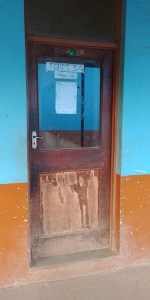
With hand outstretched, she introduces herself as one of the Sisters from the convent. When she hears my story, she goes to find the school bursar, who would be able to escort me around. As she walks away my eyes wander to the classrooms on either side of the library. Then, down to the left, the battered door to classroom 3A. My first class. The door is the same, the chalkboard new, but the chairs and desks stunningly appear in the same condition as in 1995: sturdy and uncomfortable, crooked and uneven, scarred and pitted.

You can go home again. I stand in silence.

A new voice from the courtyard brings me back as I dry my cheeks and leave the classroom. Sister Stella, the school bursar, warmly welcomes me and gives me a tour of the staffroom, all the while informing me of the whereabouts of the teachers I called friends more than twenty years ago. We chat for a long time, walk about the school compound, and I even get the opportunity to visit my old house and talk with the current owner. By the time I get back to the car and express my thanks to Sister Stella for her kindness, the school’s deputy head comes running up to me and shakes my hand.

“We’re so glad you are here, sir!” He tells me. “I’ve heard so much about you!” It’s impossible for anyone to hear much about an unexpected visitor who’s only been around for a few minutes, but his enthusiasm is genuine. We say our goodbyes.

The next morning, walking about town, I see my drunk guide, now sober. We greet each other like good friends.