See the love that’s sleeping

Thirteen years ago, I wrote a blog post titled “A Letter to My Sons” while flying somewhere over Greenland. I was on my way to work with human rights educators in Sri Lanka, and the date I wrote the letter, November 20, was World Children’s Day, the day the UN adopted the Declaration of the Rights of the Child in 1959, and also the same day 30 years later when the Convention on the Rights of the Child was adopted by the UN General Assembly.

In my letter, I attempted to explain to my children, then aged 10 and 7, what the Convention was about: “Basically, the Convention is a document – a statement, a list of things ordinary people and governments should do – to make sure that children around the world live lives that are filled with love and everything they need to make them safe and happy.” I didn’t want to get into specifics on what the Convention means – it’s more than a statement, it’s a legally binding treaty that’s been ratified by all UN member states (except the US), and while it is aspirational, as are all human rights documents, it does provide guidance for the respect, protection, promotion, and fulfillment of children’s rights.

That letter I wrote to my sons prompted me to write additional ones over the years during my trips overseas as a human rights educator. I wanted to find ways to explain to my children the work I did. Looking back at those letters, they were in many respects oversimplified, but the overarching message emerging from many of them had a common essence: do what you can to make a difference in this world. As I wrote at the end of that first letter: “…be thankful for the wonderful lives you have, and somehow do your part to make this world a better place for everyone.”

The theme for this year’s World Children’s Day on the UN website is “For every child, every right.” The website goes on to say that “children and young people are raising their voices on the issues that matter to their generation and calling for adults to create a better future. This World Children’s Day, it’s more important than ever that the world listens to their ideas and demands. On 20 November, kids are speaking out and reimagining a better future. What will you do?”

And there it is: What will you do? Sometimes, it doesn’t take a lot. A few weeks ago, I asked my wife if we should sell Christmas cards for the second year in a row and donate the proceeds to a local organization that helps adolescents and young adults living with cancer. I drew the card – finding inspiration took a few minutes, and the drawing itself took another hour or so. We ordered 600 cards which sold out in no time thanks mainly to my wife’s Facebook network. People in our community raised several hundreds of dollars in the space of a couple of weeks. All for buying Christmas cards, which, as far as I can tell, very few people take the time to write anymore. When given a chance to care, a chance to contribute to something that collectively benefits others, people can readily stand up to the task. And while I’m tremendously grateful to everyone who contributed to the fundraiser, it’s a cogent reminder that helping those within our communities, even strangers, can be a much easier ask than seeking assistance to help those far away, who in their own ways are struggling to maintain their dignity through tragic circumstances that are not of their doing.

I understand that it can be overwhelming. The statistics of civilians killed in Gaza are so shocking that the magnitude is hard to grasp; nearly 15,000 as of today, with nearly 6,000 children. The war in Ukraine has claimed over 10,000 lives since it began; 1,200 Israelis were massacred October 7; Sudan’s genocide has claimed 9,000 lives in the past seven months; the floods in Libya earlier this year claimed from 5,800 to 20,000 victims; over 300,000 victims died during ten years of the civil war in Syria; the same number is estimated from the 2010 earthquake in Haiti; 230,000 victims from the 2004 tsunami; over 11,000 children died in the Yemeni civil war. Whatever the cause of other people’s hardships – from violence committed by others or through natural disasters beyond our control – there should be space in our hearts to care. The Beatles’ song While My Guitar Gently Weeps alludes to this, albeit disparagingly:

I look at you all, see the love there that’s sleeping

While my guitar gently weeps.

George Harrison’s haunting lyrics from over half a century ago remain true. Harrison wrote of a love that remains hidden – untapped, unrealized, unfulfilled – in all of us. The meaning behind the song is prescient, given that our current age of connectivity has brought the horrors of war and shattered lives to the convenience of our smartphones with a speed that matches our ability to scroll through Black Friday and Cyber Monday savings.

If we live in a world where love is sleeping, that’s a choice we’ve made. It doesn’t have to be so. I take inspiration from the Bantu word ubuntu, meaning “I am because you are.” It impresses upon us the responsibility we have to each other, and how a meaningful, purposeful life is strengthened by demonstrating humanity towards others. In Archbishop Desmond Tutu’s words, a person with ubuntu is “open and available to others, affirming of others, does not feel threatened that others are able and good, based from a proper self-assurance that comes from knowing that he or she belongs in a greater whole and is diminished when others are humiliated or diminished, when others are tortured or oppressed.”

The wars in Gaza and elsewhere around the world are diminishing us all. We can’t turn away from a humanitarian crisis because it’s easy to do so, or because we feel our voices or our actions will have little or no impact, or because we feel safe hiding behind political ineptitude from world leaders. The children who survive war, any war – and some children have already seen more than one – will be left broken, afraid, distraught, sad and guilty for having lived while others died. They will have been deprived of safety, shelter, food, water, toilets, education, and basic health. They are living in unimaginably dire situations that would shatter most people and leave them scarred for life. Every day that goes by scrapes away their humanity, and ours.

What will you do?

I look at the world and I notice it’s turning

While my guitar gently weeps

With every mistake

We must surely be learning.

Are we?

Palestinian children play games organized by humanitarian workers as they shelter at a United Nations-run school, Khan Yunis, southern Gaza Strip, October 23, 2023. © Mahmud Hams, AFP

On Puppies and Destruction

My wife posted my blog entries on her Facebook page (I got rid my my account years ago, so her page is a primary source for channeling my writing), and, perhaps unsurprisingly, received only a few reactions. Little, if any, comments. She then posted a picture of our dog – he is unquestioningly cute – and boom, 103 likes.

Part of me understands this. The war in Gaza is horrifying, painful to watch, and seemingly unending. The violence continues as the living conditions degrade well beyond any measure of human dignity – little or no access to water, hours to wait to use a toilet, just as many hours waiting for the possibility of a loaf of bread, no electricity, dwindling access to adequate medical care, and the constant fear of bombardment. The onslaught of images has been giving me nightmares, the likes of which I have not had since the Twin Towers collapsed. The turmoil consuming the region is manifesting itself in violence in the West Bank as well – apart from the more than 11,000 casualties in Gaza, there have been 185 fatalities in the West Bank as of November 12. Combined with the continuing hostage crisis with 240 Israelis and foreign nationals held in Gaza and 1,200 Israelis killed October 7, the spillover effect of this war is being felt worldwide. Hate speech online against Jews and Arabs has spiked in the last month, and acts of violence against those communities, including shots fired multiple times at Jewish schools here in Montreal, is frightening and profoundly upsetting.

No wonder people just want to see pictures of a fluffy poodle. So do I.

But I think – or at least I hope – that we owe it to others who are suffering greatly to demonstrate a level of empathy for their plight and a capacity to act in their defence. A simple “like” on a post advocating for a ceasefire, or a humanitarian corridor, or an appeal for donations, or a call for greater understanding and kindness, is a small but meaningful act that uplifts the spirits of those advocating for change. Go a step further and sign a petition for a ceasefire; write to your Member of Parliament and urge them to advocate for one as well. Speak out against hate crimes – after the shootings at the Montreal Jewish schools over the past few days, leaders have been saying “This is not us.” Well, it is now, and we have to face it. Take a look at those puppy pictures, but don’t shy away from the rest of the crap going on around us.

We can’t shy away from the ever-deepening crisis in Gaza and its ripple effects worldwide – the igniting and re-igniting of feelings, attitudes, and beliefs that support and feed off hatred, ignorance, and fear of those we naively categorize as “others.” A recent article in the Economist by philosopher David Enoch argues that much of the public discourse on the Israel-Gaza war is “depressingly simplistic.” When media coverage focuses on Pro-Israeli and Pro-Palestinian protesters yelling at each other, as they did in the halls of my old university, Concordia, last week, it’s easy to side with this view of public discourse.

I am by no means an expert on the Israel-Gaza war; I am an educator by profession, and one who values and practices human rights. I’ve worked in Gaza and the West Bank over several years for UNRWA, and sat down with hundreds of children, parents, teachers, and human rights advocates in the Occupied Palestinian Territories to learn about peoples’ lives, understand their culture, and find some pathway to peace in which the people I worked for can find some solace in knowing that their world can be better through the appreciation and sharing of common values to all human beings – respect for others, equality and non-discrimination, inclusion, and the establishment of strong community links. These were values identified by the Palestinians I engaged with; these values came to light through the discourse that Palestinians engaged in when reflecting on the meaning of human rights. It was an understandably challenging space for many Palestinians to grapple with. During one of my first meetings, in Tripoli, northern Lebanon, I met with a group of community leaders from an UNRWA refugee camp for Palestinians. My presence was greeted with staunch, vocal opposition. “How can you speak to us of rights,” said one man, “when we have been deprived of our right to return for all these years? How can you speak of rights when we have none?”

In the end, we did speak of rights, in a manner that was meaningful to the development of children’s learning, and unique to the context of Palestinian refugees. There was no place for hate speech, there was no tolerance for discrimination, there was only space to learn about human rights. The road back to that space is out of reach for all Gazans; with 45% of homes either destroyed or damaged in the Gaza Strip, the task of rebuilding homes will be tenuous. The task of rebuilding lives traumatized by this war will last a lifetime.

I get it. More puppies, less death, destruction and despair. I want to say that the puppy stuff is necessary; we need to see stuff that will make us feel better. But we also owe it to those who are suffering – and to ourselves – not to avoid addressing the violence unfolding in Gaza. It’s OK to feel pain and empathy for the families of the hostages in Israel while also feeling sorrow and pain for the Palestinians being bombarded in Gaza – there has to be space in everyone’s hearts to empathize with all victims. This care for others also implies that moral opposition to the Israeli government’s unrelenting punishment of the Palestinian people is a statement against a government, not its people; likewise, a denouncement of the attacks perpetrated by Hamas on innocent Israeli civilians is aimed at the terrorist group, whose methods and aims are not representative of what the overwhelming majority of Palestinians espouse. One can express disagreement, outrage, and disapproval with an authority in power while advocating for the rights of ordinary people who live within that authority’s grasp.

In late October, the head of UNRWA, Philippe Lazzarini, wrote that “History will judge us all if there is no ceasefire in Gaza.” Weeks later, as the bombings continue unabated, the UN marked a sombre milestone with over 100 UNRWA employees killed since the war began. This must stop. There comes a point when the cycle of violence must end, when methods other than the indiscriminate killing of innocent civilians need to be identified as alternative means to destroy Hamas.

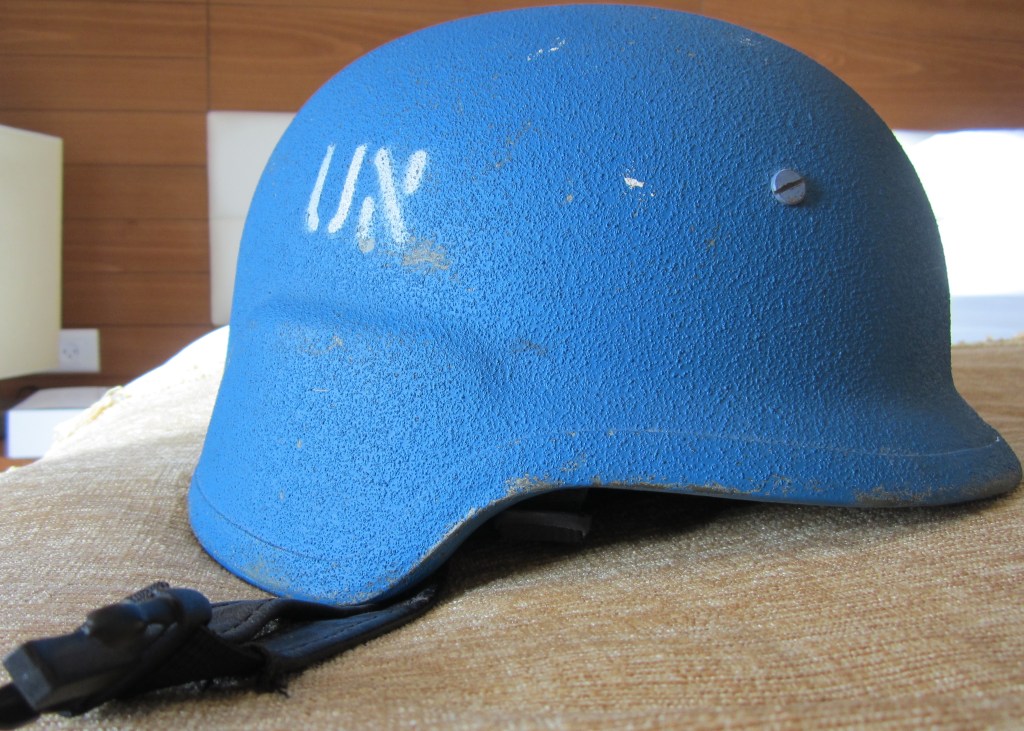
My UNRWA-issued UN helmet, during one of my trips to Gaza.

I’m reminded of a line from a book by one of my favourite authors when I was a teenager, Isaac Asimov. In the book science fiction novel Foundation, published in 1951 (Asimov started writing the book as short stories 10 years earlier, at the age of 21), one of the book’s characters says, “Violence is the last refuge of the incompetent.” He likely had no idea how prescient his writing would be decades later. Any pathway to peace must begin with the end of violence. Our collective humanity cannot suffer at the hands of the incompetent. I can hug my puppy and advocate for peace.

Words Matter

I was 10 years old the first time I was called an “ostie d’anglais” in 1980; I was in the fourth grade and some sixth graders bullied me because I had an English surname in a French school. The insult – along with others I won’t bother sharing – came at a time when tensions were high in Quebec between the French and the English. In May of that year, Quebec held a referendum on its sovereignty, with the “No” side winning by a wide enough margin. While I was bullied because I was English, my mother was feeling increasingly ill at ease around neighbours and family members who were in favour of Quebec’s independence from Canada. Tensions were high, and sometimes she didn’t know what to say.

In times when difficult, complex and polarizing issues can strain friendships, family bonds, and small talk among neighbours and acquaintances, words matter. The recent events in Israel and Gaza have prompted me to reflect a great deal on the importance of choosing the right words, in trying to carefully and clearly understand the words of others, and – just as importantly – to make sense of silence.

As I’ve written previously, the October 7 attacks by Hamas on innocent Israelis were heinous and reprehensible. Families and friends of the 1,400 victims face a lifetime of grief to compound generational trauma fuelled by the Holocaust and antisemitism. They deserve support, they deserve care – as do the more than 200 hostages and their families who are rallying tirelessly for their safe return.

I cannot put myself in the position of those who have lost loved ones to Hamas. I cannot put myself in the shoes of someone whose family went through the Holocaust. But I empathize to the extent that I can with what they are going through, and I’m seized with dread that brings me down and weakens my spirit.

The same dread tramples my heart as I see images of suffering in Gaza, with a death toll in the thousands. I cannot ever see a justification for the deaths of thousands and the continued suffering of millions of people – I said people, words matter – in the hopes of eliminating terrorists who’ve embedded themselves in an overcrowded population. These actions are pulling us further from peace than ever before.

As the violence continues to unfold, everyone’s words matter. This week, the Secretary-General of the United Nations, António Guterres said in a speech to the Security Council that he condemned unequivocally Hamas’s attacks but that they “did not happen in a vacuum.” The Israeli ambassador promptly asked for the Secretary-General’s resignation and accused him of “justifying terrorism.” I’ve listened to the Secretary-General on many occasions over the last several years; I understood what he meant, and I’m sure the Israeli ambassador did as well. The ambassador’s remarks show a predictable reaction that only further erodes the possibility of a reasoned dialogue to ever take place. Words matter.

Political rhetoric is rife with sound bites that feed into everyone’s confirmation bias, which is stoked further by pundits, social media, misinformation, and (thankfully) actual information. What is deeply upsetting is the demonization and dehumanization of Israelis and Palestinians through social media. Amnesty International noted that social media companies need to step up their game and increase efforts to combat online hate and censorship, citing a recent increase in such posts since the conflict began. Demonization and dehumanization through language only solidifies the divide between “us” and “them.” It also limits the ability for many people to engage with those who categorize and channel their worldview through dehumanization: how does one respond to a friend’s social media post who is horrified by what “our” group has gone through and how anyone from “the other” group doesn’t deserve to live? Where can you go from there? (By the way, go ahead and fill “our” group and “the other” group with whichever groups you want.) Words matter.

About 10 years ago I was at an UNRWA school in Gaza speaking to a group of young secondary school students who were members of the school’s student parliament. After they explained to me the work they did – running student elections, speaking with school management about issues affecting students, providing community outreach – they took a few minutes to ask me questions. A young girl raises her hand, says her question in Arabic, and my friend translated for me.

“Do people in other countries think we’re all terrorists?”

There have been a few times when I’ve been at a loss for words, and that was one of them. I fumbled in my response, in part because I was in shock that someone would ask me such a thing, but there was also a part of me that was so deeply saddened by that question. How demoralizing it must be to believe that the global perception of who you are as a people is reduced to labelling everyone as terrorists. In the end, I did tell her that No, it certainly wasn’t the case, you’re not seen as all terrorists, and that many people around the world were advocating for a peaceful solution and the full enjoyment of human rights for Palestinians. Words matter.

As does silence. The head of UNRWA recently wrote, speaking about the deteriorating situation in Gaza, “The generations to come will know that we watched this human tragedy unfold over social media and news channels. We will not be able to say we did not know. History will ask why the world did not have the courage to act decisively and stop this hell on Earth.” Don’t stay silent.

The current conflict has worn me down emotionally, as have others in the past (and which are still going on – Ukraine, Yemen, Afghanistan, Sudan, Syria, and on and on). The images of violence, sorrow, destruction, pain, and suffering from everyone affected is seemingly unending. In a time when words matter, I seek voices who yearn for peace, who advocate for a cease fire, who pray for an end to hostilities and a safe return of all hostages, who find space in their hearts for forgiveness, who bring people together with words that move us to hope, solidarity, and towards human rights for all.