“Maybe this world is another planet’s hell.”

I must have been about 14 when I read the above quote by Aldous Huxley. I’d purchased the science magazine OMNI, and there were always a couple of pages that had historical quotes that, depending on the issue, either destroyed or restored my faith in humanity. At the time – 1984 – the threat of nuclear war between the Americans and the USSR was palpable. Even the Doomsday Clock from the Bulletin of the Atomic Scientists crept up a few minutes to reach 3 minutes to midnight. The scientists noted in their editorial for that year, “We thus stand at a fateful juncture, at the threshold of a period of confrontation, a time when the blunt simplicities of force threaten to displace any other form of discourse…This is an appalling prospect.”

Guess what; in January of this year the folks at the Bulletin pushed the Doomsday clock to 90 seconds to midnight. In case you’re wondering, midnight is the apocalypse. As you might expect, a driving factor moving the clock forward in the past year was the war in Ukraine. At the time the Doomsday clock published its editorial, the death toll in that war was close to 7,000 after nearly one year of fighting. Just over two weeks into the Israel-Hamas war, the death toll is creeping to that figure (1,400 Israelis and over 5,000 Palestinians). Those numbers will only increase in the near future.

Much like the reflections of the Doomsday editors back in 1984, the current war between Israel and Hamas must have a better endgame other than “blunt simplicities of force.” As many commentators, analysts and activists have noted, there will come a point when Israel’s retribution wears thin with other nations, and there will be greater demands to move towards a solution that goes beyond flattening an entire population. The continued violence plays right into the hands of Hamas leaders: they do not value life, whether it’s the life of an Israeli or a Palestinian; their actions prove that. The heinous acts committed by Hamas on October 7 must never be allowed to happen again. And however painful these acts were – and their lasting consequences on families, friends, the nation of Israel, and Jews around the world, we – the most collective “We” as humans on this Earth – must find the strength to maintain our faith in humanity. As Yuval Noah Harari noted recently, “Hamas is waging war on our souls…Hamas is trying to destroy our trust in humanity, and thereby destroy our own humanity.”

It won’t win; it can’t win. But Hamas’s disregard for all human life is taking a horrendous toll on people in Gaza. Every day I wake up to see more grim statistics on the scale of human suffering. Over 600,000 people internally displaced, over 5,000 of people killed – 62% of them women and children, over 15,000 injured, buildings and homes demolished, families homeless and distraught, no access to food, electricity and water – the convoys are welcome but insufficient given the enormity of the destruction. Thirty-five UNRWA staff killed.

Peace is not an option, at least not now. An increase in the flow of humanitarian aid is imperative, as would be a cessation of the bombings that are affecting innocent civilians. There needs to be a viable, diplomatic road to peace, which does not include Hamas in any way, but rather another form of leadership from Palestinians which can come to the table with Israel – with the support from the US and neighbouring Arab nations.

We won’t get there if our humanity is chipped away by Hamas. While the diplomatic options might seem unreachable, it doesn’t mean that we – once again the big “We” of planet Earth – should remain silent observers to the unfolding violence. You can sign a petition to call for a cease fire (I signed a petition that currently has a quarter million signatures), you can donate to a reputable organization that is providing aid to Gazans (like UNRWA; I worked for them for 6 years, they are reputable, competent, and essential to saving lives in Gaza, period) or offer support for survivors of the attacks in Israel, or – and I know this is harder than it actually sounds – talk to others about it. Don’t remain silent on what happened. Even if you don’t know how to start a conversation, but you feel that you should – with a Jewish friend, or a Muslim friend, or with anyone – it’s ok to start a dialogue with “I don’t know what to say.” We can’t be afraid to speak about this because we fear tensions might flair – denial has always been a poor way to tackle any issue. Losing our humanity in the face of these events reduces our perceptions to absurd simplicities that trample our empathy and can galvanize anger, demonization, and hatred.  An appalling prospect indeed, and not one I’m willing to give into. We are not another planet’s hell.

Planting flowers in Gaza, 2014.

A Letter to My Sons: On Love and Hate

Dear Alexandre, Dear Sam,


This is my first Valentine’s Day away from you. The second away from Mommy – the first time was way back in 1998. I was living in Ghana at the time, and your mother sent me a Valentine’s Day package from home. The package wasn’t delivered to my apartment, so I had to pick it up at the central post office. People receiving packages had to open them for inspection in front of a postal worker. There was a lineup of people behind me, peeking over my shoulder to see what I got. I opened the box and showed the postal worker a CD, a letter, and a pair of red boxer shorts with little red and white hearts on it.


However embarrassing that situation was at the time (but everyone smiled), I knew I was a lucky man, and I am even luckier today. Prior to meeting your Mommy, Valentine’s Day, to put it simply, sucked. I never had a girlfriend on that day (reassuringly, most of my guy friends didn’t either), and any potential for having a girlfriend on or around that day was always promptly extinguished. I can freely provide you details in about 5 years.
All you need.
I am lucky because I have love from the two of you and Mommy that defines me, that strengthens me, supports me, gets me out of bed and brings me comfort even though I’m 9511 km away from you (more or less). It makes Valentine’s Day just another day as I sit here alone in my hotel room, happy.


There’s a saying that goes, “So much of what we know of love we learn at home.” I learned a lot from your grandmother and, in a very different way, from your Uncle John, and continue to learn from the two of you and Mommy. As I left you on Saturday, your emotions were bare, your silence painful, and your tears seared right through my heart. My trips away from you are much shorter than they were ten years ago, but somehow the goodbyes are sadder. I can only attribute that to a growing love.


Sitting here in my hotel room in Amman, it’s hard for me not to think of this day without remembering the struggles that so many people here in the Middle East and North Africa have faced over the past year. You know of the sweeping changes that took pace in Egypt, in Tunisia, in Libya. But one year ago today, February 14, protests began in the streets of Bahrain, where my friend Abdulhadi was jailed and sentenced to life in prison. He recently wrote a letter from jail talking about his situation. He is a strong man, someone who fights hard for the rights of others and has paid a high price for this. But he is loved, and that love manifests itself in the support that thousands of people from around the world have shown in pushing for his release, and the release of other prisoners.


Bahrain is not the only place where innocent people are being hurt because they are standing up for their rights. The situation in Syria is getting worse every day, with the president unwilling to give up power as his forces kill dozens of civilians every day. Tonight I spoke to my friend Amouri who lives in Syria and he says that all six of the UN schools that operate in the city of Homs have been closed now for three weeks because of the violence in the streets. It’s one thing for you to have a snow day and not go to school. Can you imagine not attending school because people are being killed in the streets?


If you think this makes no sense, you are right. I want you to always keep in mind that this is not right. Hatred will never be right. You might be confused right now about this kind of stupid behaviour, and as you get older, I’m sorry to say you might find out even stupider and more hurtful things that people do. If you’re like me, this will anger you. What I’ve learned over time is that anger is often unavoidable, but needs to be transformed. Without changing that anger, you won’t change anything. Your anger at other people’s stupidity needs to be channeled into passion and love that is tempered by reason, into a fierce enthusiasm to stop those who do wrong to others. Be a Superman, be a Batman – even SpongeBob stands up for what’s right. I want you to be yourself and to share, as much as you possibly can, what you know of love and learned from home. The world needs it.


Je t’aime Sam, je t’aime Alexandre.
Daddy


A Letter to My Sons: a little bit of happiness

Dear Alexandre, Dear Sam,


I’ve been in Gaza for three days now. This morning I travelled to the area of Middle Gaza to meet with teachers who were teaching human rights to children your age. What they had to say was really encouraging. Most of them did not know about human rights before, some openly said that they were afraid to teach human rights.  Why teach human rights, some asked, when our rights are being violated? What difference would it make?


A lot of the teachers said there was a difference among the children they taught. The children learned to respect each other, learned to respect their teachers, made sure the school was clean, became more confident at expressing themselves to teachers when something was bothering them, and plenty of other things. They also learned that they had duties as well. For example, a child has a right to be protected from violence, but if one child sees another one being bullied in the schoolyard, they have a duty – or a responsibility – to inform the teacher of what’s happening.
A lonely sight
In the end, if you teach children about human rights, they care more for each other. And it doesn’t matter which religion you believe in, which country you call home, the colour of your skin, where you live, whether you’re a girl or a boy, how rich your parents are, or anything else that defines you that should make you care more or less for someone else. If I were to ask you what’s most important in life, you’d probably say love or happiness or family and friends.


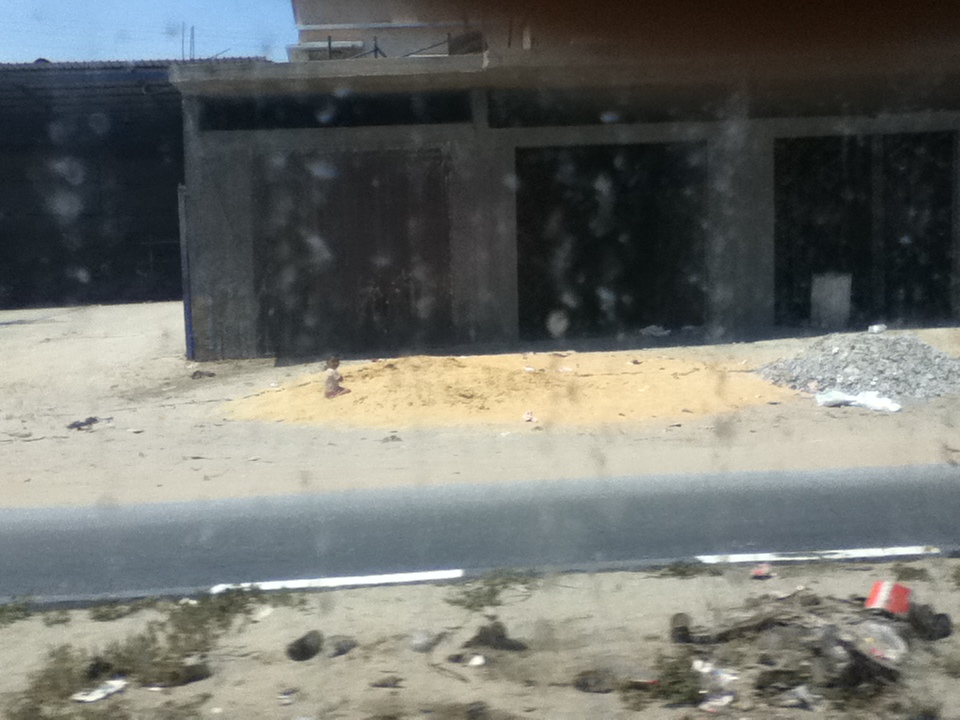
In a place like Gaza, the poverty is so astounding that it’s hard for me to find the happiness. It’s hard to see beyond the fields filled with garbage, the unfinished or torn-down buildings, the broken cars, the dead trees, the empty stores or the pathetic wooden stands by the side of the road with merchants selling a smattering of fruits. Nothing is new, everything is worn or dirty or broken or cracked. Everything I see is faded and blurry through the shaded bulletproof window of the vehicle I’m in. There was an infant playing alone in a pile of sand in front of an unfinished building; in an instant I felt a tremendous sadness at how lonely and pitiful that little girl’s life is now, and wondered what hope she would have in the future.
Yes we are having fun.
Later on, as I walked to a mosque with my friends, I came across a group of young boys who were sliding down large sheets of metal shaped like a cut pipe used to pour concrete. Not exactly a slide like the ones you play on back home. But they were happy. They smiled as I walked by and they repeated, over and over again, “Hello! How are you? What is your name? Hello? How are you? What is your name?” I don’t think they really cared what the answers were. But they smiled as they crawled up and down their makeshift slide, and I was relieved that I’d found a little bit of happiness.


Je t’aime Alexandre, je t’aime Sam.
Daddy