A Letter to My Sons, Part 6: Coming Home

Dear Alexandre, Dear Sam,


I’m coming home. As I write this final letter to you, I am sitting in my room at the Paragon Hotel, which was the first hotel I stayed at in Jakarta seven years ago. I look at my reflection in the mirror and realize that I’m wearing the same shirt I wore back then as well.

Rooftop bath, early morning, Jakarta
The hotel hasn’t changed since my first visit back when you were just a little baby, Sam. The rooms look the same, although the bed sheets are grey now instead of white. There is still at least one cockroach lying on its back to greet me in the morning before I go to the bathroom, and there’s still only one plug in the room that works. I looked out my window as I woke up and noticed two men bathing on top of the building next to me; it looked like no one ever finished constructing the building.


Up until yesterday, I played games from morning until late at night. I know, it’s hard to believe that’s my work, but it’s true. I met a wonderful group of elementary school teachers who work in schools called pesantren. Pesantren are Islamic boarding schools; in other words, they are schools like any other schools but the teachers also teach about the Islamic religion. Bing and I spent three days with the teachers showing them how to play the games from our Play It Fair book. Sam, do you remember when we went to the gym in Vancouver to see Tom and you played a game called Robots and one with Daddy called Squirrel in the Trees? We did the same thing here, only most of the teachers have never seen a squirrel before.


We came all the way here to show them how to play these games with their students because the games help kids like you to learn about important values. Some of these values are helping each other (cooperation), being nice to each other (respect), playing with other children and making them feel like someone cares (inclusion), and a few other ones too. The children play the games and then the teacher sits down and asks them if they liked the game and if they learned anything by playing it. The last game we played yesterday was Bullying. Remember how each of you came home sad because some other kids were pushing you around during recess? Remember how Mommy and I told you to stand up for yourselves and to tell the bullies to just STOP? The last time it happened, I pretended I was you Sam, and you were the bully and you jumped on me. I didn’t like it and used my words to say stop.
With two of the workshop participants.
That’s what we did when we met the teachers: we showed them how to help their students get along better with each other. The games also help everyone to become better listeners. Before playing the always-popular Noisiest Game in the World, I asked the teachers if they’ve ever been in a situation where they try to talk to their students but the students simply don’t listen. One teacher opened her eyes wide and said: “You mean it happens elsewhere? I thought it only happened in Indonesia?” There are a lot of similarities between our lives and the lives of those here in Indonesia.


We played around twenty games over three days, and there’s one clear conclusion: all the teachers love the games and can’t wait to try them out with their students. They are all convinced that the students will love the games. For me, this makes me think that no matter where you are on this planet, children love to play. And if they can learn about helping one another and being kinder while doing it, so much the better. I was really glad that the teachers were happy and had fun – I don’t think I’ve heard so much laughter in a long time. We even talked a lot about SpongeBob.


Once the workshop was over, Bing and I said goodbye to everyone and hopped in a taxi to the other side of town. After checking in to this last hotel, I went downstairs to check my email and that’s when I saw Hendy. Hendy greeted me seven years ago when I arrived in Jakarta for the first time. He’s the one who gave you those World Cup shirts and always helps me find the “poopy coffee” no one back home likes. Last night he drove us to a nice restaurant where I gobbled up a much-needed cheeseburger and guzzled a cold beer. Today he patiently waited as I got my watch fixed and went searching for cool shirts for the two of you. Every time I am in Jakarta and he’s around, he goes out of his way to see me, to help me out, to drive me around. He even showed me a pair of Darth Vader Adidas shoes that you would love, Alexandre.


I guess what I’m trying to say is that as you grow older, you realize that the dozens of friends you had as children trickles down to only a few good friends later in life, and that’s if you’re lucky. And over the years you will make new friends, like I have. Friends are worth holding on to. I miss you, Alexandre and Sam, and I think of you every day and show your photos to everyone to the point where they are probably sick of seeing them. But even though I’m far away, I want you to know that I’m in good hands, because friends like Hendy and Bing and everyone else I’ve been with over the last two weeks take care of me. Your mother always tells me to be careful when I’m away, but in a sense I know I don’t have to be, because there’s always a friend wherever I go.


Je t’aime Alexandre, je t’aime Sam, bonsoir.
 
Daddy

A Letter to My Sons, Part 5: The Good and Bad Men Do

Dear Alexandre, Dear Sam,


Here I am on the sixth floor of the Wisma Syahida in Jakarta. My bed is pale blue with large, dark blue roses and a big yellow heart in the middle with the word Happiness written across it. I’m nibbling on crackers called “Oops.”


So much has happened since my last letter I scarcely know where to begin. When I last wrote to you, our first workshop had just come to a close. I spent the following day planning another workshop with the same participants, only this time, they are the ones who will do almost all the work. There were people from six different countries, and it seems like everyone wants to have the training in their own country.


The following day began at 6 in the morning and never really ended for Bing and me because we were up the whole day. We drove to a place called Kandy, which looks close enough to Colombo on a map but nonetheless took over three hours to get there. One of the participants, Lucille, took us to see Fr. Nandana. I’d last seen him six years ago during the program we have at John Abbott College.
With Fr. Nandana and Bing in Kandy
He welcomed Bing and me as if we were old friends. He began by talking about the work he does in human rights. He has an office called the Human Rights Office, and he helps people who are tortured in prison or by police officers. The word torture is not one I have ever explained to you, but I guess you will hear the word some day if you haven’t already, so here goes. When I was your age, I used the term to exaggerate something bad that one person would do to another. For example, when Uncle John would sit on me and laugh, I told Grandmamam that your uncle was torturing me. Some people who have heard me sing call that a form of torture as well. At your age, my understanding of what torture really meant was fuelled by cartoons and comic books depicting torture devices from the Dark Ages hundreds of years ago. Long tables where people would be stretched by their hands, or shackles would suspend a person for hours or even days from a ceiling, or a person’s head would be shoved underwater to scare them into thinking they will drown.


Torture is a form of punishment to force people to admit to things they have or have not done – sometimes they admit to the truth, sometimes they lie just because the pain is too much to handle. Fr. Nandana told us many stories of innocent people who were captured by the police and tortured in the nearby prison. As Fr. Nandana spoke, I became more and more upset and the stories he was relating. He told us the story of one young man who was tortured so badly that he lost sensation in one of his arms because his nerves were damaged. He’s since been released from prison, and we met him when we were invited to Fr. Nandana’s church; he cooked two delicious meals for us, and he is now studying to work in the hotel business.


Torture affects not only the people who are hurt but also their friends and families, and sometimes it takes a long time for people to recover. One of the things Fr. Nandana does is bring people together to express their feelings about being tortured and what it was like for their loved ones. These gatherings are called “Testimony therapy for the holistic wellness of our ex-prisoner survivors.” He invited Bing and me to attend one of the sessions in the afternoon, after touring a beautiful Buddhist temple and forcing us to rest at a convent for an hour (the chance to rest was desperately needed and much appreciated).
Dancers participating in the therapy testimony
We were ushered into the room in which the testimonies were to take place, two empty chairs waiting for us up front. There were two sets of testimonies that day. The first was from a young man named Benedict and his family. Benedict had wrongly been accused of doing something very bad to a friend, and because of this he was put in jail. He was eventually proven innocent and released, but he suffered a lot while in jail, and so did his family. Their testimonies – or stories, if you will – were read out loud to all of us after a ceremonial lighting of an oil lamp. Another set of testimonies came from the family of a man named Chithrakuma, and while he was not present, his mother, wife and two young children – younger than you – arrived to tell their stories. In between the stories were beautiful dances by young girls all dressed the same.


It’s when I saw Chithraluma’s children sitting there, the younger one asleep in his mother’s arms, the older one sitting quietly next to her, that I thought you would be ready to hear about the meaning of torture. Perhaps I’m wrong, but I figure you might as well hear about torture through the efforts of the people in this world who are trying to fix the broken lives of those who have been hurt by others. What greater gift can a victim of torture receive than the chance to express themselves to others about their feelings, about the struggles they faced, and how they overcame the most painful of situations imaginable? What greater gift can you offer these victims other than to listen to their stories with compassion and empathy?


It is rare that I have the opportunity to see the work our former participants do, and I am very happy I took the time to pass through Kandy. If only you were here, Alexandre and Sam, the things you would see, the people you would meet, the stories you would hear, and the kindness bestowed upon you would leave you with nothing short of a sense of wonder and profound appreciation of the kindness of others.


I’ll stop now. I need to get ready for the second day of our Play It Fair workshop for teachers here in Jakarta. I’ll write more about that when I can.


Je t’aime, alexandre, je t’aime Sam, bonsoir.
Daddy


A Letter to My Sons, Part 4: The Trouble Tree

Dear Alexandre, Dear Sam,


It’s Friday night and the rain is coming down in sheets. We had the last day of our workshop yesterday, and worked as hard as we could in order to finish before lunch. The main thing the participants were supposed to do was to write a list of things we call “good practices.” They used to be called “best practices,” but I guess that put too much pressure on people making them up, so they went from best to good.


At any rate, a good practice in human rights – the stuff participants do – should essentially be a good example of things people do so that other people can learn from them. For example, if you wanted to share with other kids some “good practices” on making your parents happy, you can read through the examples that Alexandre started in his new book, like:
  • Making your bed every morning to make your parents happy.
  • Doing your homework to make your parents happy.
  • Eating your food to make your parents happy.
  • Going to bed when you’re told in order to make your parents happy.
You get the point. Examples of bad practices are like the ones you have in the book you’re writing, Sam, “How to Annoy Your Parents.” I won’t go into details, but you get the point.
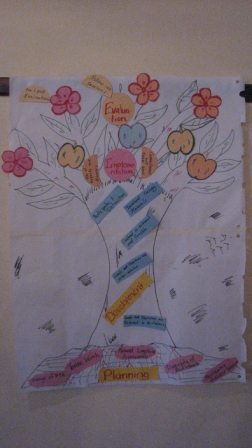
“Good Practices.” artwork by Lucille, Bernat, and Madan.
At any rate, the participants had to write up good practices related to their work. Specifically, good ideas for planning, doing, and evaluating their human rights education activities. As a head start, we gave them the notes from another region around the world that did the same exercise.


Something didn’t rest well with me. I felt like I was asking them to add on to someone else’s work and that it would be boring. So they did something different: instead of writing down things in a computer, they split up into four different groups and all came up with different ways of showing their good practices. Aruna and Khan made a PowerPoint presentation; Father George, Maria, and Lal (the guy with the umbrella) pretended to do television interviews; Samson, Hameed, Saru and Banasree wrote a nice story about friends who meet in a magical place called Dhulikhel; and Bernat, Lucille and Madan created a tree out of paper and cardboard to show their good practices. You would have liked helping them out with their tree. To me, it was one of my happier moments in any workshop, because each group came up with something fantastic and creative in the space of one hour. It was a great way to end the workshop.


There are a number of things my friends said over the past few days that have stayed in my mind. One is a story from Sam in Pakistan. His organization’s website has a news item of a woman named Asiya Bibi who might die because of something she said. There’s a law in Sam’s country called a “blasphemy law.” Blasphemy is when a person says something bad about a god. This woman, a mother to five children, said something against the Holy Prophet Muhammad (the things he said a long time ago helped form the basis of Islam, a religion). She was jailed for saying those words, and under Pakistani law, she has to be sentenced to death. Writing this to you makes me realize even more than before how utterly ridiculous something like this is. You may be wondering how such a thing could possibly happen in this world, and yet unfortunately it is happening. At least there are some organizations like Sam’s which are trying to tell people that the woman deserves the chance to live.


The story of this woman is still in my mind, and it will likely linger there for a while. To be honest with you, it sometimes gets to the point when listening to bad story after bad story brings me down. I try to find hope in the stories from friends like Sam and the others at this workshop, but it’s hard. I basically have a job because this world is not a happy place for the thousands of children who have to act as soldiers, the millions of women who are hurt by their boyfriends or husbands, the hundreds of millions of people who live in poverty or who have never been to school. It weighs a person down; well it weighs me down, anyway. There are times – lots of times – when I come home from work and all I want to do is to forget about the world outside. I want you to show me the goofy pictures you drew, or show me your latest LEGO creation, or see the homework you’ve done or just read a story. Someone, I can’t remember if it was your mother or not, told me the story of a man who was not happy with his job. His work depressed him a lot. However, every evening before walking through the front door of his house, he hung up his troubles on his trouble tree and left them hanging. He walked into his house and greeted his family with a smile, having forgotten about his troubles. More than once I’ve had to remind myself to hang up my troubles on my tree and walk into the house knowing that what matters to me the most is waiting to hug me before I take off my coat.


Je t’aime, Alexandre, je t’aime Sam, bonsoir.


Daddy