A Letter to My Sons: On Love and Hate

Dear Alexandre, Dear Sam,


This is my first Valentine’s Day away from you. The second away from Mommy – the first time was way back in 1998. I was living in Ghana at the time, and your mother sent me a Valentine’s Day package from home. The package wasn’t delivered to my apartment, so I had to pick it up at the central post office. People receiving packages had to open them for inspection in front of a postal worker. There was a lineup of people behind me, peeking over my shoulder to see what I got. I opened the box and showed the postal worker a CD, a letter, and a pair of red boxer shorts with little red and white hearts on it.


However embarrassing that situation was at the time (but everyone smiled), I knew I was a lucky man, and I am even luckier today. Prior to meeting your Mommy, Valentine’s Day, to put it simply, sucked. I never had a girlfriend on that day (reassuringly, most of my guy friends didn’t either), and any potential for having a girlfriend on or around that day was always promptly extinguished. I can freely provide you details in about 5 years.
All you need.
I am lucky because I have love from the two of you and Mommy that defines me, that strengthens me, supports me, gets me out of bed and brings me comfort even though I’m 9511 km away from you (more or less). It makes Valentine’s Day just another day as I sit here alone in my hotel room, happy.


There’s a saying that goes, “So much of what we know of love we learn at home.” I learned a lot from your grandmother and, in a very different way, from your Uncle John, and continue to learn from the two of you and Mommy. As I left you on Saturday, your emotions were bare, your silence painful, and your tears seared right through my heart. My trips away from you are much shorter than they were ten years ago, but somehow the goodbyes are sadder. I can only attribute that to a growing love.


Sitting here in my hotel room in Amman, it’s hard for me not to think of this day without remembering the struggles that so many people here in the Middle East and North Africa have faced over the past year. You know of the sweeping changes that took pace in Egypt, in Tunisia, in Libya. But one year ago today, February 14, protests began in the streets of Bahrain, where my friend Abdulhadi was jailed and sentenced to life in prison. He recently wrote a letter from jail talking about his situation. He is a strong man, someone who fights hard for the rights of others and has paid a high price for this. But he is loved, and that love manifests itself in the support that thousands of people from around the world have shown in pushing for his release, and the release of other prisoners.


Bahrain is not the only place where innocent people are being hurt because they are standing up for their rights. The situation in Syria is getting worse every day, with the president unwilling to give up power as his forces kill dozens of civilians every day. Tonight I spoke to my friend Amouri who lives in Syria and he says that all six of the UN schools that operate in the city of Homs have been closed now for three weeks because of the violence in the streets. It’s one thing for you to have a snow day and not go to school. Can you imagine not attending school because people are being killed in the streets?


If you think this makes no sense, you are right. I want you to always keep in mind that this is not right. Hatred will never be right. You might be confused right now about this kind of stupid behaviour, and as you get older, I’m sorry to say you might find out even stupider and more hurtful things that people do. If you’re like me, this will anger you. What I’ve learned over time is that anger is often unavoidable, but needs to be transformed. Without changing that anger, you won’t change anything. Your anger at other people’s stupidity needs to be channeled into passion and love that is tempered by reason, into a fierce enthusiasm to stop those who do wrong to others. Be a Superman, be a Batman – even SpongeBob stands up for what’s right. I want you to be yourself and to share, as much as you possibly can, what you know of love and learned from home. The world needs it.


Je t’aime Sam, je t’aime Alexandre.
Daddy
 

A Letter to My Sons: a little bit of happiness

Dear Alexandre, Dear Sam,


I’ve been in Gaza for three days now. This morning I travelled to the area of Middle Gaza to meet with teachers who were teaching human rights to children your age. What they had to say was really encouraging. Most of them did not know about human rights before, some openly said that they were afraid to teach human rights.  Why teach human rights, some asked, when our rights are being violated? What difference would it make?


A lot of the teachers said there was a difference among the children they taught. The children learned to respect each other, learned to respect their teachers, made sure the school was clean, became more confident at expressing themselves to teachers when something was bothering them, and plenty of other things. They also learned that they had duties as well. For example, a child has a right to be protected from violence, but if one child sees another one being bullied in the schoolyard, they have a duty – or a responsibility – to inform the teacher of what’s happening.
A lonely sight
In the end, if you teach children about human rights, they care more for each other. And it doesn’t matter which religion you believe in, which country you call home, the colour of your skin, where you live, whether you’re a girl or a boy, how rich your parents are, or anything else that defines you that should make you care more or less for someone else. If I were to ask you what’s most important in life, you’d probably say love or happiness or family and friends.


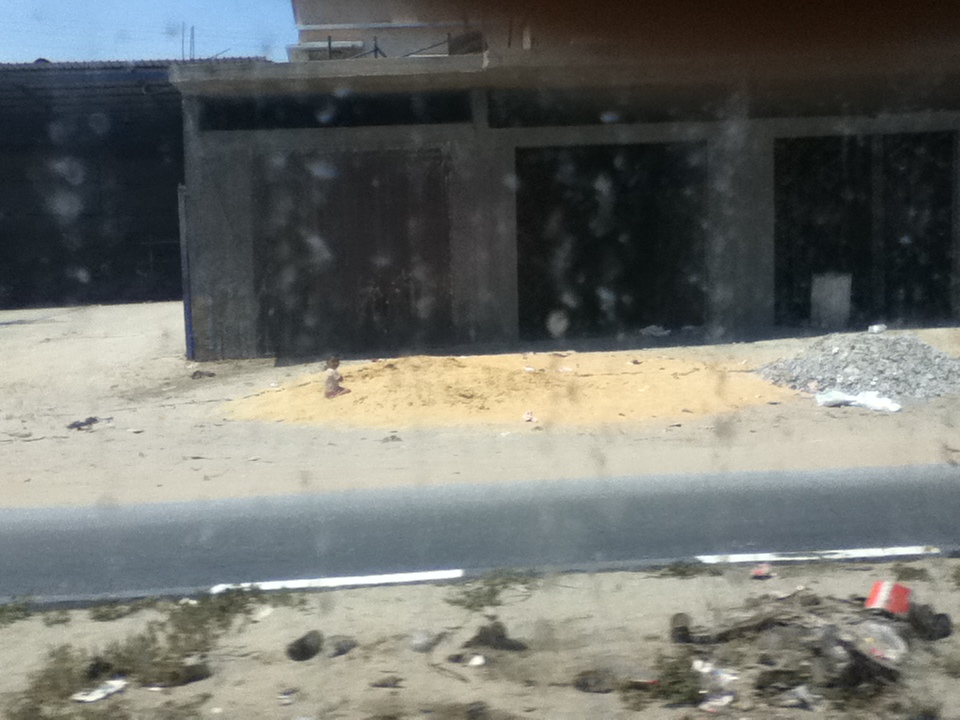
In a place like Gaza, the poverty is so astounding that it’s hard for me to find the happiness. It’s hard to see beyond the fields filled with garbage, the unfinished or torn-down buildings, the broken cars, the dead trees, the empty stores or the pathetic wooden stands by the side of the road with merchants selling a smattering of fruits. Nothing is new, everything is worn or dirty or broken or cracked. Everything I see is faded and blurry through the shaded bulletproof window of the vehicle I’m in. There was an infant playing alone in a pile of sand in front of an unfinished building; in an instant I felt a tremendous sadness at how lonely and pitiful that little girl’s life is now, and wondered what hope she would have in the future.
Yes we are having fun.
Later on, as I walked to a mosque with my friends, I came across a group of young boys who were sliding down large sheets of metal shaped like a cut pipe used to pour concrete. Not exactly a slide like the ones you play on back home. But they were happy. They smiled as I walked by and they repeated, over and over again, “Hello! How are you? What is your name? Hello? How are you? What is your name?” I don’t think they really cared what the answers were. But they smiled as they crawled up and down their makeshift slide, and I was relieved that I’d found a little bit of happiness.


Je t’aime Alexandre, je t’aime Sam.
Daddy


A Letter to My Sons: This Is Gaza

Dear Alexandre, Dear Sam,


I’m in a place called Gaza now, overlooking the Mediterranean Sea in a hotel room that has far too much red in it for my tastes. Red curtains, red blanket, red carpet. The beach outside is filled with young children splashing in the water and playing on the beach, the occasional parent sitting or standing nearby. It’s beautiful, and it’s full of garbage.


It’s difficult to explain to you why things are like this. Gaza and another place nearby called the West Bank form what people call the Palestinian territories. Palestinians claim these territories as their land. There has been a struggle – a very long struggle – to fight for this land with the Israelis.


Before coming here, a friend of mine told me that the difference between Israel and Gaza would be incredible. It was. Driving along the road in Israel, I was surrounded by a lush landscape of trees and farmland as far as the eye could see. People drove around in nice cars. The houses they lived in, at least the ones I could see from the highway, were beautiful. Then everything changed. There were no more cars, no more people, no more houses, the road got smaller and bumpy, the grass disappeared, all we could see was dirt, and then we came across some signs to slow down. At that point I saw a huge wall with barbed wire on top. The wall seemed as though it went on forever. We had to stop at a checkpoint, give our passports to three different people (all of whom were quite friendly), and pass by a few men with guns slung over their shoulders. The gates of the wall opened slowly – very slowly. And more than one gate was opened in order to finally get through to Gaza.


The difference in the landscape was immediate. Old rusted vehicles darted the landscape, goats chewed on garbage, and there were plenty of people, mostly young men and even some children your age, who were idling around, not doing much. The buildings were old and worn down, the donkeys looked equally worn, as did the cars and their drivers. We had to get into bulletproof vehicles to drive to the office. But don’t worry: I asked someone with me if anything bad had ever happened to her in the two years she’d been here, and she said no.


I met a lot of nice people today who are working hard to include human rights in schools. Here in Gaza, children your age learn about human rights – they even have one classroom period per week to discuss the subject. In many ways, what is being done here is a lot more advanced than in other countries around the world. This despite living conditions that are horrible. As I came back to the hotel this evening, I drove by three young boys who were foraging through garbage by the side of the road. When I stop to think of you doing something like that, my heart aches. We often talk of “human dignity” when speaking of human rights, and it was really hard to see it in their eyes. If you saw what I did today, I know you would be scared. I know you would cry. I know you would ask how people could live like this. I know you would ask what we could do to help. I wish I knew the answers. All I can say is that deliberate ignorance of the harsh lives of others will not make their lives better, but knowing about their lives moves us towards greater empathy for their sorrow. Hopefully that’s what pushes us to help, and to me that’s what makes us human.


Je t’aime Alexandre, je t’aime Sam.
Daddy