
A Letter to My Sons: Eternal Good Evenings

Dear Alexandre, Dear Sam,

There’s a jazz band in the hotel garden with a heavy bass that’s shaking the table as I write to you, my cold Nile Special beer sweltering in the evening heat. I’ve been here nearly three weeks and just checked in to my flight, a long journey back home starting tomorrow night. My first trip to Uganda was exhausting but productive, and while the report I write with my colleagues will be completed by the end of next month, I will have more lasting memories of the places I visited and the people I met.

I was reminded early in my journey that a formal greeting to a friend or stranger is commonplace, if not expected; one always finds the time to say good morning, good afternoon, or good evening. You are expected to wait for the response, and only then can the conversation properly continue. It’s something I hadn’t experienced in a long time, not since my days living in Ghana, and it was a pleasant reminder that simple courtesies matter. It slows down the pace. It gives you time to smile to the person you’re talking with. A few times in our journey across the country we were lost, looking for a guesthouse, a school or a district office. To stop someone by the side of the road and ask for directions would never be as curt as “Excuse me, where is the Golden Courts Guesthouse?” No. “Good evening,” our driver would say. “Good evening,” the response from a man by the side of the road, approaching us as our driver rolled down his window. And then the discussion, go down this road, turn left, take the first exit at the roundabout. In some cases, when the roads were windy or circuitous, the person we’d ask directions from would hop on his boda boda and personally escort us to our destination.

The band is now playing an instrumental of “Isn’t She Lovely.” The temperature has cooled now that the sun’s down, the patrons in the hotel’s garden area are sitting at their tables with friends, sipping their juice cocktails or Nile beers, the occasional lonely traveller like me typing away on an Excel spreadsheet or something that looks just as boring.

Last week I had the opportunity to meet students, many of them your age, who have benefited from a scholarship program that helps them throughout high school. All were happy to have received their scholarship, most of whom told me that without it, they might not have gone to secondary school. Can you imagine stopping school back when you were 11 or 12? Many of them come from small villages not unlike the ones we passed by as we drove across the country. Let me tell you what I saw.

Driving on the main road up to Arua near the border with the Democratic Republic of Congo, you get a sobering sense of the toll that drought has taken on the population. Without rain for months, the landscape is scorched yellow as far as you can see. A spattering of dried patches of grass become congregation areas for emaciated goats and cows chewing on meager offerings amidst a scenery blotted with used plastic bags: black, blue, transparent, they are omnipresent, on the ground, stuck in trees, half-burned, in ditches, by the side of the road. It’s as disgusting as it is sorrowful. Massive tree trunks add to the desolation, ancient trees once tremendous and hallowed sit crippled by the side of the road, cut down by villagers, their stumps jutting out of the ground, robbed of most of their branches used for firewood to heat up what would likely be a family’s only meal of the day. You see some men walking by the side of the road, most of their shirts a dull red brown that could have been white a long time ago. You look to your left and see boys playing in a ditch with a stick, shoeless, half-naked and crusted with dirt. Dozens of girls walk on either side of the road, barefoot for the most part, clothed in filthy tattered dresses shredded with time; you know it’s probably the only thing they own. Each girl is holding a yellow plastic jerrycan in her hands if she’s going towards the borehole to fetch water, or on her head if she’s making her way home, a balancing act she masters for a few hundred metres, a kilometre or two, or more. The brightest spots are the school uniforms worn by students on their way back from school; sometimes a bright purple, other times canary yellow. They walk together for the most part, taking up both sides of the road, a blaze of solid colours to spare me from the arid landscape. They seem to go on forever, until finally, a few kilometres ahead, we pass by the school, and see just as many students walking home in the other direction. I try to calculate how long some of them likely walk to get to school, and the best estimate I come up with is anywhere from a few minutes to three hours. And they do this every school day, twice a day. To sit in a classroom with on crappy chairs, to share a text book if they’re lucky, to listen to a teacher whose only resource might be a lousy piece of chalk that scribbles on a bumpy chalkboard that might have been black a long time ago but is now faded.

I think of the lives of children your age who grow up in these villages and I want to dismiss the urge to feel pity. Theirs is a resilience that is admirable. Living a day in their shoes, I suspect most teenagers you know would cower in desperation. It is a life nearly bereft of opportunities, but not, I would hope, of dreams. Unfortunately, even for those who complete their secondary education, their options are limited, and should they find gainful employment, their obligations to support family members will dwindle any savings away. It is a life of obligations, a life of duty and responsibility to family, a life guided as much by a parent’s decisions as an unquestionable and unwavering faith in God.

Having met some children from places not unlike what I’ve described, the reality is that they are no different from you. They stress about exams at school, they act silly in the absence of any adult, and they laugh at my corny jokes probably more out of respect than humour. Like you, they have dreams of who they want to be when they grow up; doctors, lawyers, engineers and nurses. I can’t say that I admire them, because their lives are not nearly as easy as ours, but I am thankful for such trips because they remind me of the respect that others in less fortunate circumstances deeply deserve. It’s a respect that helps me listen to their stories with rapt attention. One boy your age took his savings to buy a goat to help his family. One girl a little older than you used her savings to pay the school fees of a younger girl in her village who otherwise would not have access to primary school. A group of boys your age donated a dollar a month of their precious pocket money to help another student in need. No one obliged them to do these things; they are acts of kindness, acts that reflect their upbringing which reminds them to help others – “It is more blessed to give than to receive.”
As I spend my last day on a continent I called home for four years, I down my now-warm beer and head back to my hotel room. The security guard near the elevator looks up from her Bible as I approach. She stands and presses the button to summon the elevator. “Good evening,” she tells me with a smile. “Good evening,” I reply. I notice my own smile reflected in the mirror as I step into the elevator.

Je vous aime, les boys,
Dad
 

A Letter to My Sons: City of Dreams, Gaza

Dear Alexandre, Dear Sam,


I’m back in Jerusalem, writing to you from the comfort of a guesthouse that’s part of a cathedral over one hundred years old. It’s relatively quiet save for the traffic outside my window, my room is sparse but pleasant, with archways defining a ceiling three times my height, and a garden a few steps away that a travel enthusiast would probably label as quaint or charming.


I do my best to appreciate my surroundings, but doing so after a trip to Gaza only compounds the conflicting thoughts I have in processing what I’ve just experienced. I have felt sadness and anger, frustration and disbelief, despondency and despair; yet in equal measure I have seen tenacity and hope, cheerfulness and gentleness, dedication and stoicism.


Over three years ago, in my first letter to you from Gaza, I described the beach view from my hotel window as “beautiful, and it’s full of garbage.” This time, my hotel offered a similar view, although added to the garbage were piles of rusted scrap metal and heaps of crumbled concrete. The scenery going through town and all over the Gaza Strip wasn’t all that different; it was dirty, but once in a while you saw a massive, stinking garbage bin in which people with busted brooms dumped their crap. There were occasional mounds of concrete where buildings once stood. Once in a while you’d see a mosque or an apartment building that would look fine and you’d wonder why no one was in it until you’d turn the corner and realize the front had been bombed to pieces, steel rods sticking through pulverized foundations.


There are no traffic lights that work. Banged up cars share the road with carts pulled by ragged donkeys and emaciated horses, trucks that would have failed any road safety check just about anywhere else on the planet, and a parade of international vehicles including the armoured one I was in. Billboards have layer upon layer of faded, posterized martyrs either looking thoughtful or brandishing guns and rocket launchers. The buildings are grey and brown and the roads are just as drab. There are plenty of people milling about, some merchants selling fruits and vegetables in their carts, others smacking the dust off their displays of children’s clothing or cheap toys made in China. Flocks of uniformed students pour out from the walled schools and flood the streets with their brightly coloured cheap backpacks adorned with Dora the Explorer, SpongeBob, and Mickey Mouse always offering their best smiles. Candy wrappers littering the ground mark the students’ homeward journeys.


As we drove up to the blue gates of one school yesterday, the words “We need homes” were spray painted in red. After the violence and destruction that shook Gaza last summer, there are still thousands of people who have no homes left, and with winter’s sting approaching, the suffering of many will only worsen.


I felt tremendous trepidation coming to Gaza this time. I wanted to know how people were doing without prying. When I asked a friend how things were, he looked at me and spoke with his usual, even tone: “My father passed away two days before the end of the war.” Upon seeing my face, he went on to explain that his father did not die as a result of the violence this past summer, but that he’d been battling illness for some time. Still, I reflected somberly, how horrible for his last days to be spent under the veil of constant fear.


My friend told me that it was the first time he’s ever felt truly frightened and helpless. “We were staying at a safe house at one point,” he told me. “I received a call telling me that the house was going to be bombed within five or ten minutes. But when I phoned the police, they could not verify the threat. I didn’t know what to do, so I told the people inside the house about the threat, and they kept on asking me to tell them what to do. But how could I know what was right? What if I told them to go elsewhere and that place would be bombed? How can I have this responsibility to tell someone what to do? I can’t do that, I simply can’t.”


He decided to stay in the safe house and insisted others make their own decision as to stay or go. In the end, everyone stayed and the house was not bombed. His story reflects only one moment from that horrible time, a time in which he, like so many others, felt defenseless. The depth of fear and despair Gazans suffered was enough for many people I met to label what happened as a “war,” whereas in the past, there were conflicts or incursions.


People are still recovering from the devastation; later that day my friend said his colleagues went to the beach “for stress relief because of the war.” Going to the beach doesn’t sound like much, but when there is so little to begin with, a group of colleagues going to the beach together is as much therapy or freedom or stress relief or faith in God to keep their spirits up and show up for work tomorrow.


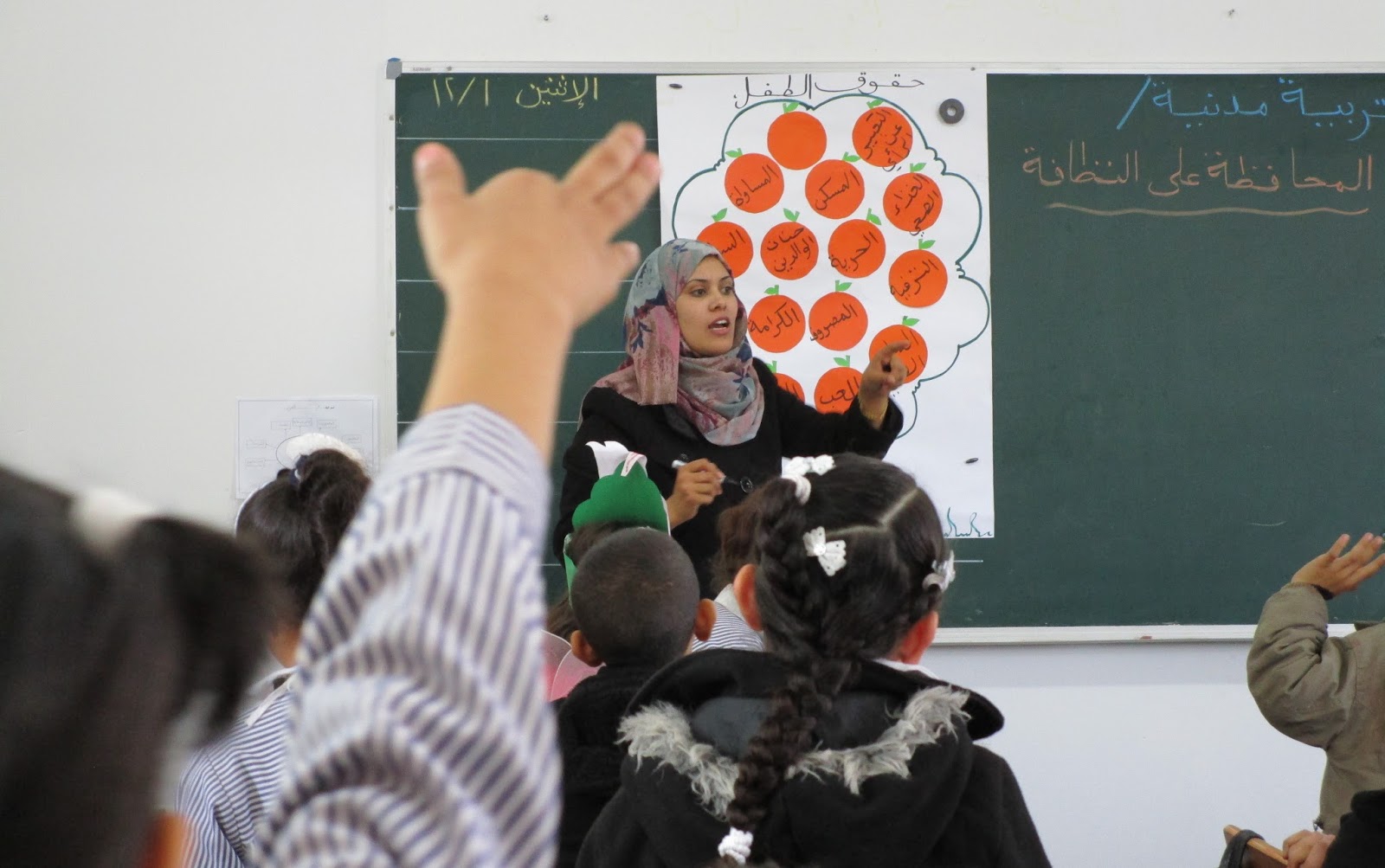
The teachers I met over the past three days play a significant role in helping children keep their spirits up while providing a safe and sheltered environment in school. I saw them encourage students to express themselves, to be creative, to participate in class and to proudly assert the rights they have, or at least should have. In one activity in which Grade 3 students drew a new city where they would all like to live, one student showed his artwork and explained to the class, “This is Freedom City. And there’s a school here, because that’s where we go to learn.” Another child’s city was “City of Dreams,” and was drawn next to the sea.


To a cynic, such an activity is meaningless, and if anything gives false hope to children who will more than likely live in poverty for years to come. But human rights education has always been more than learning about rights. It’s about helping create a culture of human rights among all people so that we can live a life of dignity and treat others as we would want to be treated by them. Hoping for a City of Dreams in a place that is so often associated with despair, destruction, and hate gives me reason to believe that today’s children will have the strength to dream and contribute towards a better world than the one we’re living in. If a child can do that while living in Gaza, there’s still hope that they will be kinder than those who today act only through violence.


I guess I’m hoping for a City of Dreams too.


Je t’aime Alexandre, je t’aime Sam.


A Letter to My Sons: Clowning Around

Dear Alexandre, Dear Sam,

I’m sitting in a restaurant by the beach. The orange glow of the sun is fading and poised to sink into the Mediterranean. A few moments ago there were a couple of kites shaped like snakes flying high in the breeze above the laughter and screams of joy from children splashing in the sea. The music is playing, couples are taking photos of each other next to the sunset. Many of the women are smoking their shisha pipes, something that wouldn’t be considered appropriate just a short distance away on the other side of the street. The mood could only be described as festive. There’s even a man dressed in a saggy dog costume with a Santa hat on his head hugging children and having their parents take pictures.

This place could be any seaside restaurant, but it isn’t. For those who come here, it’s a refuge from the reality on the other side of the restaurant’s walls. The roads are filthy and in disrepair, trampled upon by scraggy donkeys pulling wooden carts and sad-looking battered cars with broken mirrors, dented fenders, and hanging exhaust pipes. The shops that were open when I drove into Gaza City earlier today sold a smattering of dust-covered cheap toys and clothes imported from China – Mickey Mouse, SpongeBob, and Spider-Man are on countless schoolbags, sandals, and t-shirts at every street corner. The occasional dirt-covered shop window yields a passing glimpse of the promise of a better future: delicately embroidered wedding gowns hugging old mannequins. Posters of gun-toting men at every roundabout are a severe reminder that any foreseeable future is likely to be guided by violence.

Go ahead, make a change in someone’s life, even if it’s only a smile.

I want to believe that the conditions most people are suffering through in Gaza are not the result of their own actions. I want to believe that their poverty is not a consequence of their hatred but of longstanding circumstances shaped by people in power on all sides of the conflict. The average Gazans sitting next to me at these tables tonight are happy; they are enjoying each other’s company as they sit with friends and family under a warm summer evening sky. They are like other Gazans I have met in past journeys: their conversations are lively and spirited, their smiles genuine. The only really mean looking people I’ve ever seen were the guys on the posters holding guns up to the sky.


I asked a friend of mine the other day whether or not he thought there would be peace in Palestine during his lifetime. He didn’t hesitate to say no. Having worked with people here for many years, I unfortunately agree with him. However, my fatalism should never be an excuse not to attempt to create a change that can make things better, at least a little bit. 

A clown just showed up honking a horn and being chased by a group of young children. He’s got the right idea, that clown.

Je t’aime Alexandre, je t’aime Sam, Daddy