
A Letter to My Sons, Part 5: The Good and Bad Men Do

Dear Alexandre, Dear Sam,


Here I am on the sixth floor of the Wisma Syahida in Jakarta. My bed is pale blue with large, dark blue roses and a big yellow heart in the middle with the word Happiness written across it. I’m nibbling on crackers called “Oops.”


So much has happened since my last letter I scarcely know where to begin. When I last wrote to you, our first workshop had just come to a close. I spent the following day planning another workshop with the same participants, only this time, they are the ones who will do almost all the work. There were people from six different countries, and it seems like everyone wants to have the training in their own country.


The following day began at 6 in the morning and never really ended for Bing and me because we were up the whole day. We drove to a place called Kandy, which looks close enough to Colombo on a map but nonetheless took over three hours to get there. One of the participants, Lucille, took us to see Fr. Nandana. I’d last seen him six years ago during the program we have at John Abbott College.
With Fr. Nandana and Bing in Kandy
He welcomed Bing and me as if we were old friends. He began by talking about the work he does in human rights. He has an office called the Human Rights Office, and he helps people who are tortured in prison or by police officers. The word torture is not one I have ever explained to you, but I guess you will hear the word some day if you haven’t already, so here goes. When I was your age, I used the term to exaggerate something bad that one person would do to another. For example, when Uncle John would sit on me and laugh, I told Grandmamam that your uncle was torturing me. Some people who have heard me sing call that a form of torture as well. At your age, my understanding of what torture really meant was fuelled by cartoons and comic books depicting torture devices from the Dark Ages hundreds of years ago. Long tables where people would be stretched by their hands, or shackles would suspend a person for hours or even days from a ceiling, or a person’s head would be shoved underwater to scare them into thinking they will drown.


Torture is a form of punishment to force people to admit to things they have or have not done – sometimes they admit to the truth, sometimes they lie just because the pain is too much to handle. Fr. Nandana told us many stories of innocent people who were captured by the police and tortured in the nearby prison. As Fr. Nandana spoke, I became more and more upset and the stories he was relating. He told us the story of one young man who was tortured so badly that he lost sensation in one of his arms because his nerves were damaged. He’s since been released from prison, and we met him when we were invited to Fr. Nandana’s church; he cooked two delicious meals for us, and he is now studying to work in the hotel business.


Torture affects not only the people who are hurt but also their friends and families, and sometimes it takes a long time for people to recover. One of the things Fr. Nandana does is bring people together to express their feelings about being tortured and what it was like for their loved ones. These gatherings are called “Testimony therapy for the holistic wellness of our ex-prisoner survivors.” He invited Bing and me to attend one of the sessions in the afternoon, after touring a beautiful Buddhist temple and forcing us to rest at a convent for an hour (the chance to rest was desperately needed and much appreciated).
Dancers participating in the therapy testimony
We were ushered into the room in which the testimonies were to take place, two empty chairs waiting for us up front. There were two sets of testimonies that day. The first was from a young man named Benedict and his family. Benedict had wrongly been accused of doing something very bad to a friend, and because of this he was put in jail. He was eventually proven innocent and released, but he suffered a lot while in jail, and so did his family. Their testimonies – or stories, if you will – were read out loud to all of us after a ceremonial lighting of an oil lamp. Another set of testimonies came from the family of a man named Chithrakuma, and while he was not present, his mother, wife and two young children – younger than you – arrived to tell their stories. In between the stories were beautiful dances by young girls all dressed the same.


It’s when I saw Chithraluma’s children sitting there, the younger one asleep in his mother’s arms, the older one sitting quietly next to her, that I thought you would be ready to hear about the meaning of torture. Perhaps I’m wrong, but I figure you might as well hear about torture through the efforts of the people in this world who are trying to fix the broken lives of those who have been hurt by others. What greater gift can a victim of torture receive than the chance to express themselves to others about their feelings, about the struggles they faced, and how they overcame the most painful of situations imaginable? What greater gift can you offer these victims other than to listen to their stories with compassion and empathy?


It is rare that I have the opportunity to see the work our former participants do, and I am very happy I took the time to pass through Kandy. If only you were here, Alexandre and Sam, the things you would see, the people you would meet, the stories you would hear, and the kindness bestowed upon you would leave you with nothing short of a sense of wonder and profound appreciation of the kindness of others.


I’ll stop now. I need to get ready for the second day of our Play It Fair workshop for teachers here in Jakarta. I’ll write more about that when I can.


Je t’aime, alexandre, je t’aime Sam, bonsoir.
Daddy
 

A Letter to My Sons, Part 4: The Trouble Tree

Dear Alexandre, Dear Sam,


It’s Friday night and the rain is coming down in sheets. We had the last day of our workshop yesterday, and worked as hard as we could in order to finish before lunch. The main thing the participants were supposed to do was to write a list of things we call “good practices.” They used to be called “best practices,” but I guess that put too much pressure on people making them up, so they went from best to good.


At any rate, a good practice in human rights – the stuff participants do – should essentially be a good example of things people do so that other people can learn from them. For example, if you wanted to share with other kids some “good practices” on making your parents happy, you can read through the examples that Alexandre started in his new book, like:
  • Making your bed every morning to make your parents happy.
  • Doing your homework to make your parents happy.
  • Eating your food to make your parents happy.
  • Going to bed when you’re told in order to make your parents happy.
You get the point. Examples of bad practices are like the ones you have in the book you’re writing, Sam, “How to Annoy Your Parents.” I won’t go into details, but you get the point.
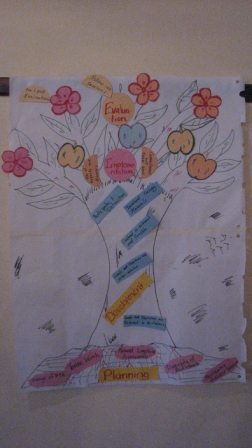
“Good Practices.” artwork by Lucille, Bernat, and Madan.
At any rate, the participants had to write up good practices related to their work. Specifically, good ideas for planning, doing, and evaluating their human rights education activities. As a head start, we gave them the notes from another region around the world that did the same exercise.


Something didn’t rest well with me. I felt like I was asking them to add on to someone else’s work and that it would be boring. So they did something different: instead of writing down things in a computer, they split up into four different groups and all came up with different ways of showing their good practices. Aruna and Khan made a PowerPoint presentation; Father George, Maria, and Lal (the guy with the umbrella) pretended to do television interviews; Samson, Hameed, Saru and Banasree wrote a nice story about friends who meet in a magical place called Dhulikhel; and Bernat, Lucille and Madan created a tree out of paper and cardboard to show their good practices. You would have liked helping them out with their tree. To me, it was one of my happier moments in any workshop, because each group came up with something fantastic and creative in the space of one hour. It was a great way to end the workshop.


There are a number of things my friends said over the past few days that have stayed in my mind. One is a story from Sam in Pakistan. His organization’s website has a news item of a woman named Asiya Bibi who might die because of something she said. There’s a law in Sam’s country called a “blasphemy law.” Blasphemy is when a person says something bad about a god. This woman, a mother to five children, said something against the Holy Prophet Muhammad (the things he said a long time ago helped form the basis of Islam, a religion). She was jailed for saying those words, and under Pakistani law, she has to be sentenced to death. Writing this to you makes me realize even more than before how utterly ridiculous something like this is. You may be wondering how such a thing could possibly happen in this world, and yet unfortunately it is happening. At least there are some organizations like Sam’s which are trying to tell people that the woman deserves the chance to live.


The story of this woman is still in my mind, and it will likely linger there for a while. To be honest with you, it sometimes gets to the point when listening to bad story after bad story brings me down. I try to find hope in the stories from friends like Sam and the others at this workshop, but it’s hard. I basically have a job because this world is not a happy place for the thousands of children who have to act as soldiers, the millions of women who are hurt by their boyfriends or husbands, the hundreds of millions of people who live in poverty or who have never been to school. It weighs a person down; well it weighs me down, anyway. There are times – lots of times – when I come home from work and all I want to do is to forget about the world outside. I want you to show me the goofy pictures you drew, or show me your latest LEGO creation, or see the homework you’ve done or just read a story. Someone, I can’t remember if it was your mother or not, told me the story of a man who was not happy with his job. His work depressed him a lot. However, every evening before walking through the front door of his house, he hung up his troubles on his trouble tree and left them hanging. He walked into his house and greeted his family with a smile, having forgotten about his troubles. More than once I’ve had to remind myself to hang up my troubles on my tree and walk into the house knowing that what matters to me the most is waiting to hug me before I take off my coat.


Je t’aime, Alexandre, je t’aime Sam, bonsoir.


Daddy


A Letter to My Sons, Part 3: Uncommon Friends

Dear Alexandre, Dear Sam,


Sorry I couldn’t write sooner, fatigue got the better of me last night. We’ve just completed the second day of our three-day workshop evaluating human rights education activities undertaken by the participants. Today we spent most of the day listening to the main points of each activity. There were participants from Sri Lanka, George, Aruna and Lucille, who told us of a workshop that brought together people from four different religions – Catholic, Hindu, Buddhist, and Islam – in order for them to understand more about human rights and how they relate to their religions. We also heard from Bernat and Maria from India, who work with teachers to develop school clubs where they discuss human rights.


Next up was Khan from Afghanistan. He told us about a workshop he held on how to write reports to the United Nations; these reports describe the current situation of human rights in the country. Before we took a break for lunch, Saru and Medan from Nepal shared with us the story of their workshop, where they taught young men and women on something that’s called “domestic violence against women.” That one’s a bit harder to explain. Not every family is one where everybody is happy. There are times when husbands and boyfriends hurt their wives and girlfriends, sometimes with words, sometimes with their hands, and it’s a problem that happens in a lot of places but people find it hard to talk about. A lot of women who get hurt find it hard to talk about it. So Saru and Medan wanted to tell young people about this problem so they could help stop it.


After lunch, Banasree and Lal showed us the journey they took to a village to meet with community leaders and people who work for organizations called NGOs; they helped to educate them more on their rights. And finally, Samson and Hameed from Pakistan told us about their workshop where they trained people from organizations like NGOs on being better at what they do.


So you see, Alexandre and Sam, despite some bad things that are happening around the world, there are some people like my friends here who are doing good things; they are trying to help people. In many ways, that’s the greatest gift you can give to others, whether they be friends, family, or even strangers. People help each other out because it’s just right to do so. I really believe it’s ingrained in our hearts.


You’ll notice that I called these people my friends. It’s true that they are “participants” in this meeting, but the reality is that once you get to know someone, to understand who they are and what their motivations are for doing this kind of human rights work, you can’t help but share a connection with them. It’s a connection, a bond that lasts once the meeting is finished and once we’ve returned to our respective homes. It’s the type of friendship that can easily skip a few years then be rekindled by an email or a phone call. As I said to my friend and colleague Bing tonight, “They’re a good group,” to which she quickly nodded. You’d like them too. I’m pretty sure you’d get the biggest kick out of Lal. He makes everyone laugh instantly, sometimes by his laugh alone. Tonight he bought an umbrella – I have honestly never seen anyone as happy as Lal at the purchase of such a thing, he was beyond ecstatic. If someone can get that excited over buying an umbrella, think of how much fun he has teaching others about their rights.


I’m off to sleep now. Je t’aime, Alexandre, je t’aime Sam, bonsoir.


Daddy